
For travelers whose main goal is to experience Croatia itself, a small-ship Croatia cruise is the better choice. For travelers who want to sample several Mediterranean countries in one trip, or who value big-ship amenities like Broadway-style shows and multiple restaurants, a large Adriatic or Mediterranean cruise may suit them better.
The two are often compared because they share a coastline, but they are very different products. A big-ship Mediterranean cruise is built around the ship, with Croatia usually appearing as one or two port days on a route that might also include Venice or Trieste, Kotor, Corfu, and the Greek islands. A small-ship Croatia cruise is built around the coast, spending a full week among Croatian islands and harbor towns that large ships cannot reach.
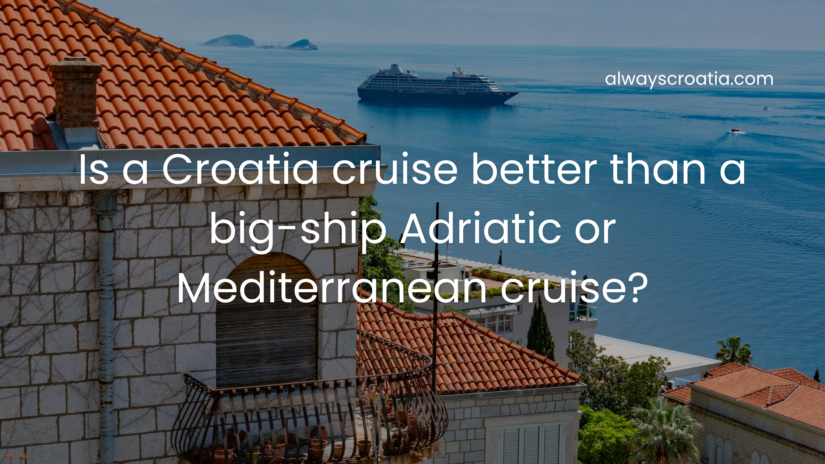
This guide compares small-ship and big-ship cruising in the Adriatic on the points that matter most: ports and time ashore, life on board, excursions, real cost, and crowds.
| Small-ship Croatia cruise | Big-ship Adriatic or Mediterranean cruise | |
|---|---|---|
| Guests on board | Around 30 to 40 | Typically 2,000 to 6,000+ |
| Time in Croatia | A full week | Usually 1 or 2 port days |
| Ports | Six or seven Croatian towns and islands, such as Hvar, Korčula, Mljet, and Brač | Larger ports such as Dubrovnik and Split |
| Docking | Right on the town waterfront | Cruise terminal or anchored offshore with tender boats |
| Nights | Usually docked in town | Usually at sea, sailing to the next country |
| Excursions | Included guided tours with local guides | Optional, booked and paid separately |
| Dining | Fresh regional cuisine, small dining room, local restaurants ashore | Multiple restaurants and buffets on board |
| Entertainment | Swim stops, talks on Croatian history, live local music | Theaters, casinos, pools, nightly shows |
| Atmosphere | Intimate, relaxed, social | Resort-style, lively, anonymous |
The central difference is where the trip happens. On a large ship, the ship is the destination and the ports are day visits. On a small ship, the destination is Croatia, and the ship is a comfortable floating hotel that moves with the traveler.
This is where the two styles differ most for anyone who wants to see Croatia properly.
Which ports. Large cruise ships need deep-water berths or open anchorages, so their Croatian stops are mostly limited to Dubrovnik, Split, and occasionally Zadar, Šibenik, Hvar, or Korčula by tender. A small ship can slip into the harbors of smaller islands and fishing towns, such as Mljet’s national park, Bol on Brač, Makarska, Trogir, Vis, or Ston.
How guests get ashore. In Dubrovnik, ships of every size berth at the commercial port of Gruž, a short bus or taxi ride from the old town, and the largest liners sometimes anchor offshore and shuttle passengers in by tender. Elsewhere on the coast, small ships usually tie up right on the town quay, a short walk from the old town gates, with no tender queues or timed shuttle tickets.
How long in port. A typical big-ship port day lasts eight to ten hours, with an all-aboard time in the late afternoon. Most guests see the highlights in a hurry and return to the ship before evening. On a small-ship Croatia cruise, the ship usually stays in port overnight, so guests experience each town after the day visitors have left: the evening promenade, dinner at a harbor-side konoba, and quiet streets in the morning.
The result is a very different number of Croatian experiences. A seven-night small-ship cruise typically visits six or seven towns and islands, compared with one or two on a broader Mediterranean itinerary.
Large Mediterranean cruise ships are floating resorts. Guests can choose among a dozen or more restaurants and bars, pools and water slides, spas, casinos, theaters, and nightly entertainment. For travelers who enjoy that variety, the ship itself is a major part of the vacation.
A small-ship Croatia cruise offers a quieter, more personal experience. With around 18 cabins, the ship feels closer to a boutique hotel than a resort. The crew learns guests’ names within a day or two, meals are served in a single dining room, and the sun deck becomes a shared living room between ports. Entertainment comes from the coast itself: swim stops in turquoise bays, talks on Croatian history and culture, and a captain’s dinner with live local music.
Social life differs as well. On a ship of several thousand passengers, most interactions are with a travel companion and passing strangers. On a small ship, guests share tables, excursions, and conversations over the week, and friendships formed on board often continue long after the trip.
There are trade-offs. Small ships generally have no elevators, cabins are compact, and there is no theater or casino. Large ships offer more cabin categories, including suites with large balconies, and full accessibility features such as elevators and wheelchair-accessible cabins.
On a large cruise ship, shore excursions are sold separately and are designed to move hundreds of guests efficiently. A typical Dubrovnik excursion might be a coach transfer, a guided walk with a group of 30 to 40 people following a numbered paddle, and some free time before returning to the ship. These tours cover the highlights, but they leave little room for anything more personal.
On a small-ship Croatia cruise, guided excursions are usually part of the fare, and groups are small by design. Because the whole ship is the size of one big-ship tour group, local guides can take guests into places that would be impossible at scale:
These experiences are often what guests remember most. They also explain why small-ship cruising in Croatia is sometimes described as a land tour that happens to travel by sea.
On headline price, big-ship Mediterranean cruises often look cheaper. A seven-night sailing in an inside cabin can start well below $1,500 per person, while Always Croatia’s seven-night small-ship cruises start from $2,395 per person.
The headline fare tells only part of the story, because the two prices include very different things. A fair comparison adds the extras most big-ship guests end up paying:
| Cost item | Big-ship cruise | Small-ship Croatia cruise |
|---|---|---|
| Base fare (7 nights) | Lower, especially for inside cabins | From $2,395 per person |
| Breakfast and lunch | Included in main dining rooms and buffets | Included daily, plus welcome and captain’s dinners |
| Shore excursions | Typically $80 to $200+ per person, per port | Group excursions included |
| Daily gratuities | Usually added automatically per person, per day | Crew tips at guests’ discretion |
| Drinks | Often sold by the glass or as a package | Varies by ship and itinerary |
| Airport transfers | Usually extra | Included |
Once a sea-view cabin, a few shore excursions, gratuities, and transfers are added, the gap between the two often narrows considerably, and the small-ship fare includes a full week in Croatia rather than one or two days.
Big-ship cruises remain the more economical choice for travelers who are happy with an inside cabin, explore ports independently, and want to see several countries in one trip.
Dubrovnik’s old town covers a small area inside its walls, and on days when several large cruise ships are in port, the main street, the Stradun, can become crowded by mid-morning. Big-ship guests often arrive at exactly the same hours as thousands of others, which shapes their impression of the city.
In response, Dubrovnik has introduced limits on the number of cruise passengers and tour buses allowed each day, following a similar approach to Venice, which has restricted large cruise ships from its historic center since 2021. These measures have eased some of the busiest days, but peak-season mornings in Dubrovnik and Split remain busy.
Small-ship guests experience the same cities differently. Because the ship stays in port overnight, there is time to walk Dubrovnik’s walls early or late in the day, and most nights are spent in smaller harbor towns such as Korčula, Hvar, or Makarska, where evenings belong largely to locals and overnight visitors.
At the smaller islands, the contrast is even greater. Places like Mljet, Vis, and Šolta see few large-ship passengers at all, and they remain some of the most peaceful corners of the Adriatic.
A large Adriatic or Mediterranean cruise is the stronger choice in several situations:
Some travelers combine both. A big-ship cruise offers a broad first look at the Mediterranean, and a later small-ship Croatia cruise returns for the full, unhurried version of the coast.
For travelers who want to experience Croatia in depth, a small-ship cruise offers strong value. It visits six or seven Croatian towns and islands in a week, docks in town centers, and usually includes guided excursions, daily meals, and airport transfers.
Most big-ship Adriatic and Mediterranean itineraries include one or two Croatian ports, usually Dubrovnik and sometimes Split, with eight to ten hours in each.
Some large ships call at Hvar or Korčula by anchoring offshore and taking passengers ashore by tender boat. Smaller islands such as Mljet, Vis, and Šolta are rarely on big-ship itineraries.
Small-ship cruises use motor vessels with private en-suite cabins, a full crew, a dining room, and a cruise manager. Sailing yacht trips are smaller and more hands-on, and some are aimed at younger travelers.
Yes. Most guests on culture-focused small-ship cruises are between their mid-40s and mid-70s. The main consideration is that small ships usually have stairs between decks and no elevators.
Headline fares for big-ship Mediterranean cruises are often lower. Once excursions, gratuities, transfers, and cabin upgrades are added, the difference usually narrows significantly, and the small-ship fare covers a full week in Croatia.
A small-ship Croatia cruise is the better choice for travelers who want Croatia to be the heart of the trip. It offers a full week on the coast, six or seven towns and islands instead of one or two, docking in town centers, overnight stays in port, and cultural experiences that large ships cannot offer.
A big-ship Adriatic or Mediterranean cruise is the better fit for travelers who want to sample several countries, enjoy resort-style amenities, need full accessibility features, or are looking for the lowest possible entry price.
The two are less competitors than different kinds of travel. One shows the Mediterranean from the deck of a resort. The other shows Croatia from its harbors, vineyards, and family tables.
Itineraries, ships, and departure dates are available on Always Croatia’s small-ship cruises and Croatia cruise ships pages, and the team can be reached at (844) 629-4848 with questions about specific sailings.

Written by Mariana Baričević · October 30, 2026
Mariana Baričević is a Destination Specialist at Always Croatia. Born in Zagreb and raised in the U.S., she now splits her time between both countries and loves helping travelers discover the Croatia she grew up with, from its famous coast to its lesser-known corners.


 7 Nights

